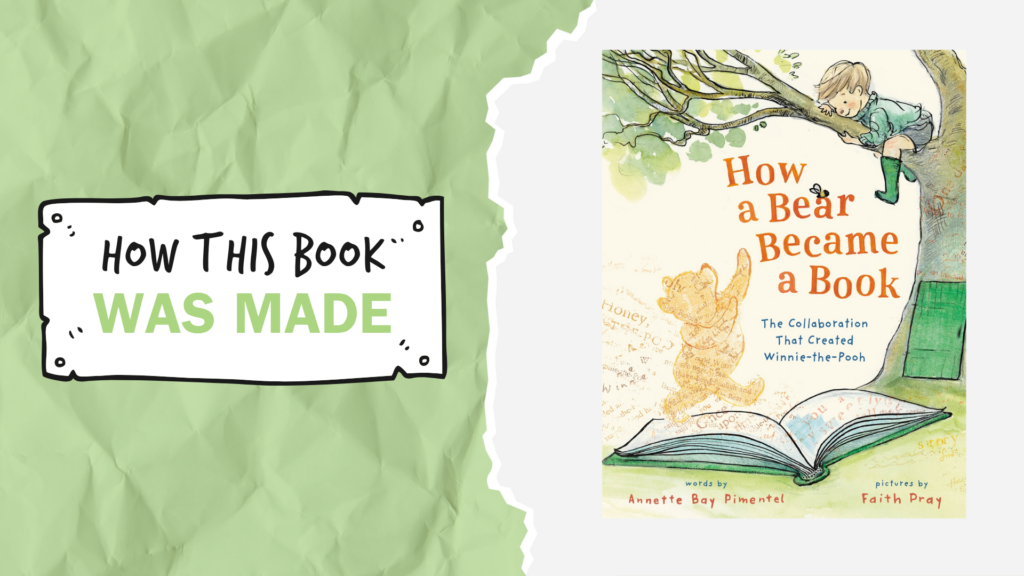
Go behind the scenes of How a Bear Became a Book by Annette Bay Pimentel and Faith Pray, the unforgettable story of the collaboration that created the world’s favorite bear.
Read on for an interview with Mark Podesta, Editor at Holt Books for Young Readers, Melisa Vuong, Designer, Annette Bay Pimentel, author, and Faith Pray, illustrator of How a Bear Became a Book. Plus, find behind-the-scenes images from the process!
Once you’ve fallen in love with the art and story behind this book, enter for a chance to win an art print from the book.
Mark: I will admit, when I first received Annette’s manuscript, I couldn’t quite picture what this book could be. But over time, and thanks to Annette’s own vision, I couldn’t shake the feeling that something special was here.
Annette, what were the early days of the writing process for you? This is quite a conceptual book, and I wonder how the inspiration struck!
Annette: Mark, it sends a chill through me that you couldn’t picture it from the start! Ai yi yi. I’m so glad you had the vision to stick with it!
This was originally a straight picture book biography of E.H. Shepard. I have loved his art since I first read the books when I was seven or eight years old, and I wanted to celebrate that. But my early drafts were flat, boring, and just not very cozy. One of them even had the refrain, “Alan and Ernest were not friends.”
Since Winnie-the-Pooh is an old book, I experimented with an old-fashioned voice, with direct address to the reader. Some of my critique partners wondered if that was actually a character talking. Their reaction surprised and intrigued me. So, in the eleventh draft of the manuscript, I tried making Pooh comment on the narration. His voice broke the logjam and immediately brightened the manuscript. The story became a conversation and stayed that way through all the subsequent versions, until it landed on your desk.
Melisa, early on, Mark and I talked about how important the illustrations were going to be to this book. I’m wondering whether you had a vision for the art immediately or if it grew over time.
Melisa: Regarding vision and when the manuscript got to me, I was in between as it was fuzzy at the beginning. I could see the conversation happening, but I think visually I was curious how it would be executed. Faith, however, really did solidify the vision once her first sketches of thumbnails had come in.
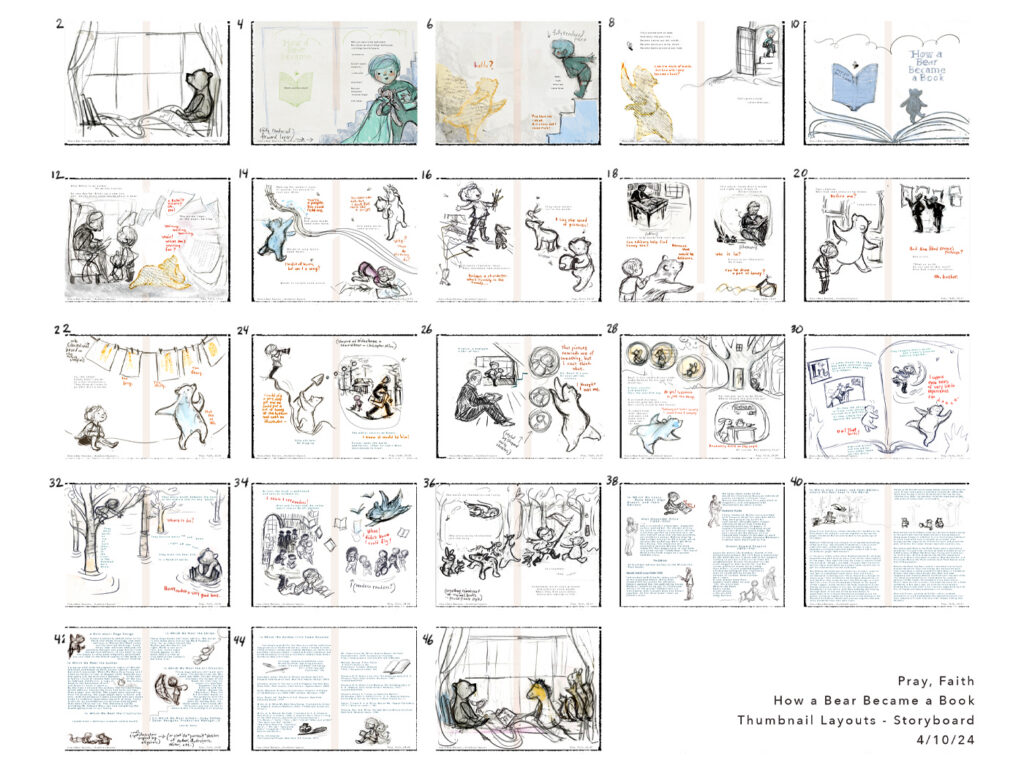
Faith, were there multiple versions of the thumbnail sketches before we saw them for the first time? Or was your vision for the book clear from the start?
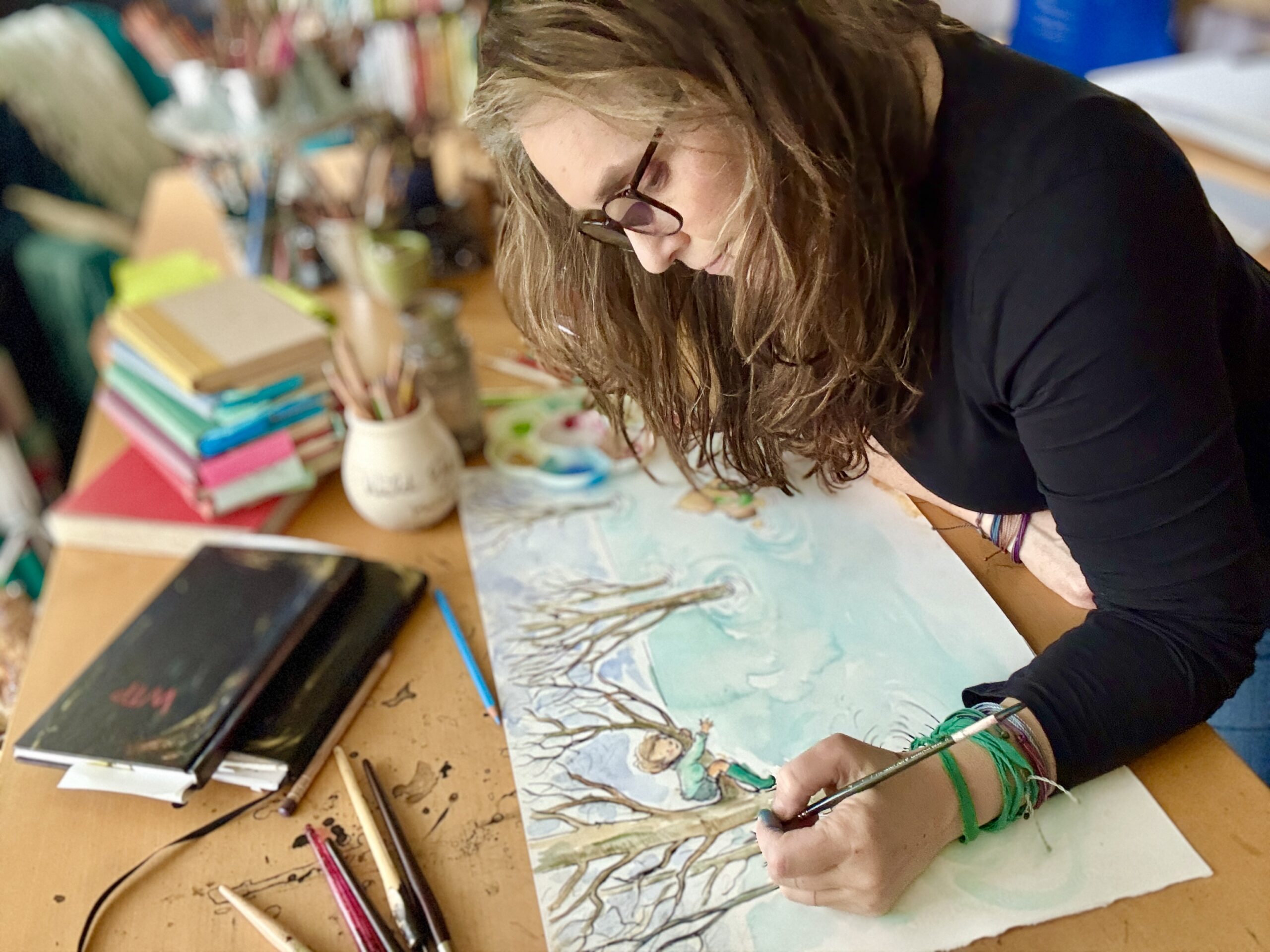
Faith: The very first email I had from Mark felt like an invitation to push my illustrative storytelling boundaries, and all the creative chaos within me started to buzz with ideas. I spent several months researching, tracking down everything I could about Ernest Shepard’s life and work, doing master studies, sketching, and playing with mediums, trying to soak up a deep understanding of our subject, and then figuring out how to capture the essence of this collaborative, sort of meta story on the page. The text has overlapping threads that I wanted to bring to life – not just the historical story we wanted to tell, but also the interactive narrator, who brings the reader in as part of the story as well, and of course, the voice that gradually becomes our Bear made of words.
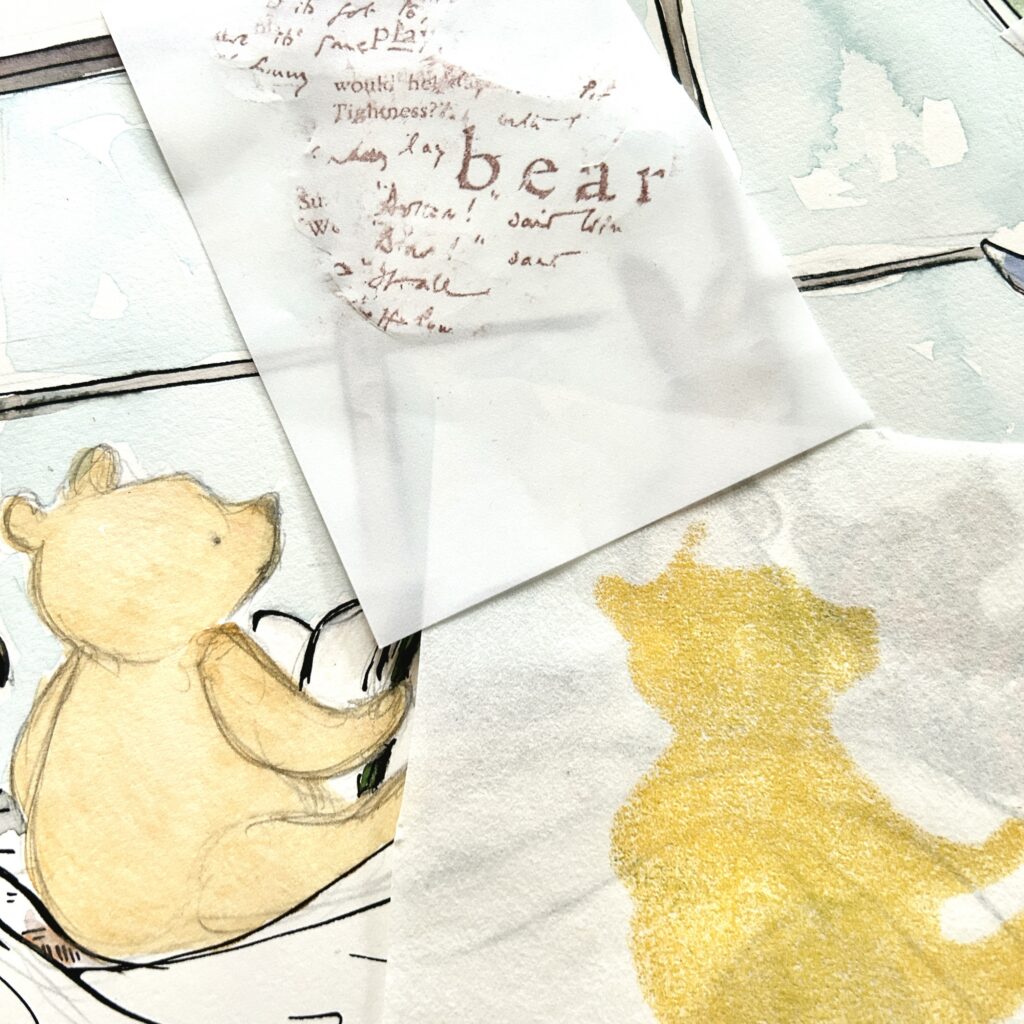
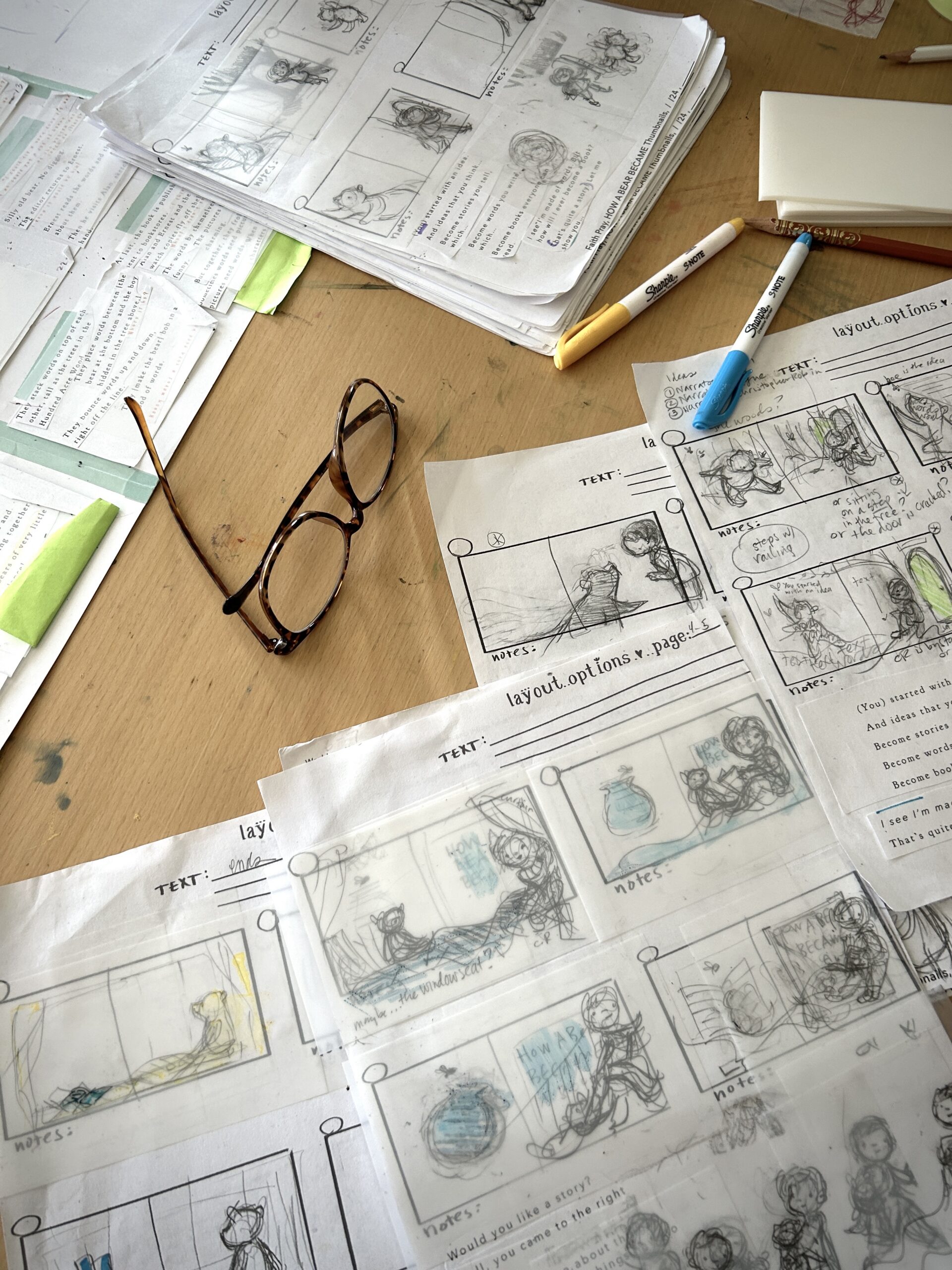
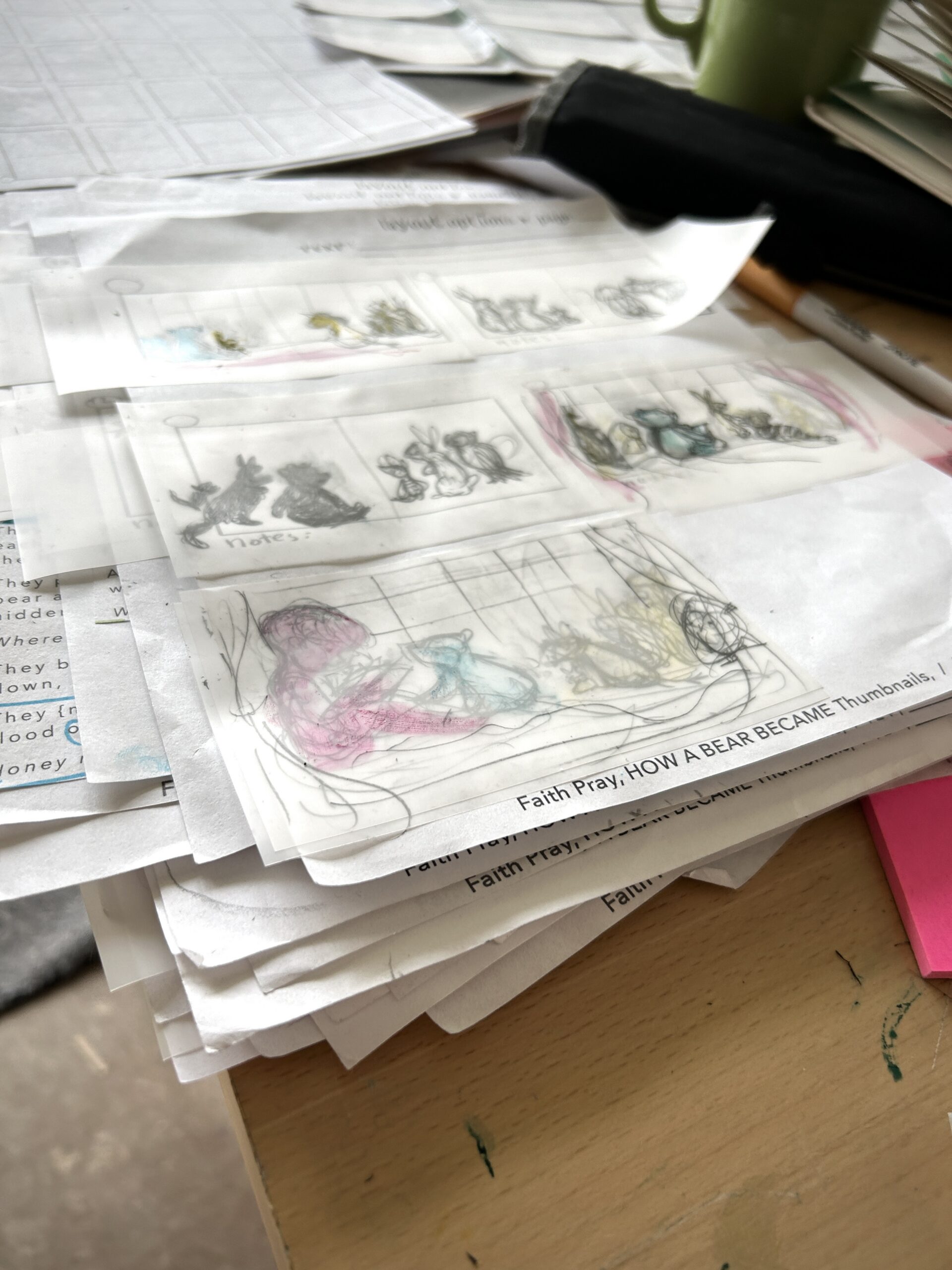
All of that to say that I spent a good deal of time puzzling out how to layer all those elements together on the page. Early on, I realized each separate thread could be illustrated with a different art medium, so that the reader could better distinguish them from each other. So I mapped out each spread with transparent sticky notes — and thumbnail sketched each element on a different, color coded layer. I picked my top three or four thumbnails for each spread, and sent them to you and Markto pick which ones worked best.
Mark, what was your favorite part of the editing process, and were there any surprises along the way?
Mark: I am going to cheat slightly and give two answers. My first was seeing your final art come in and having the opportunity to share it with Annette for her own review. I love sharing final art with writers, especially when they are such big fans of the illustrator bringing their words to life. I get to be like: Look! Nothing could have prepared you for how beautiful this is.
Also, I remember meeting with Melisa after receiving your final and both of us having a hard time providing any feedback because it just looked that good. That’s secretly the best place to be in, though. When the work is that great, the challenge becomes how can we keep upping the ante? That’s when I have the most fun.
I felt that during the manuscript stage, too, which brings me to my other favorite memory, when Annette sent me back a revision that focused on perfecting Pooh’s voice. I had a huge smile on my face when I read her revisions because it was as if Pooh was alive again in my mind. I was brought back to my childhood, and was very touched. I was also so happy to see another side of Annette’s writing. She nailed his Pooh-isms. It felt like we had perfected something.
Melisa, do you remember when Faith’s first round of final art came in? Do you have a favorite spread in the book? And what was it like getting to design the text inside?
Melisa: I was so blown away by what Faith created, it was difficult to provide feedback of any sort. Seeing Pooh gradually solidify and become more than just a concept of words and ideas was one of my favorite parts of Faith’s artwork in general. In terms of a favorite spread, I do keep coming back to the last endpapers where all the characters are sweetly together. Those endpapers spark so much joy—I could have it as a print on my wall!
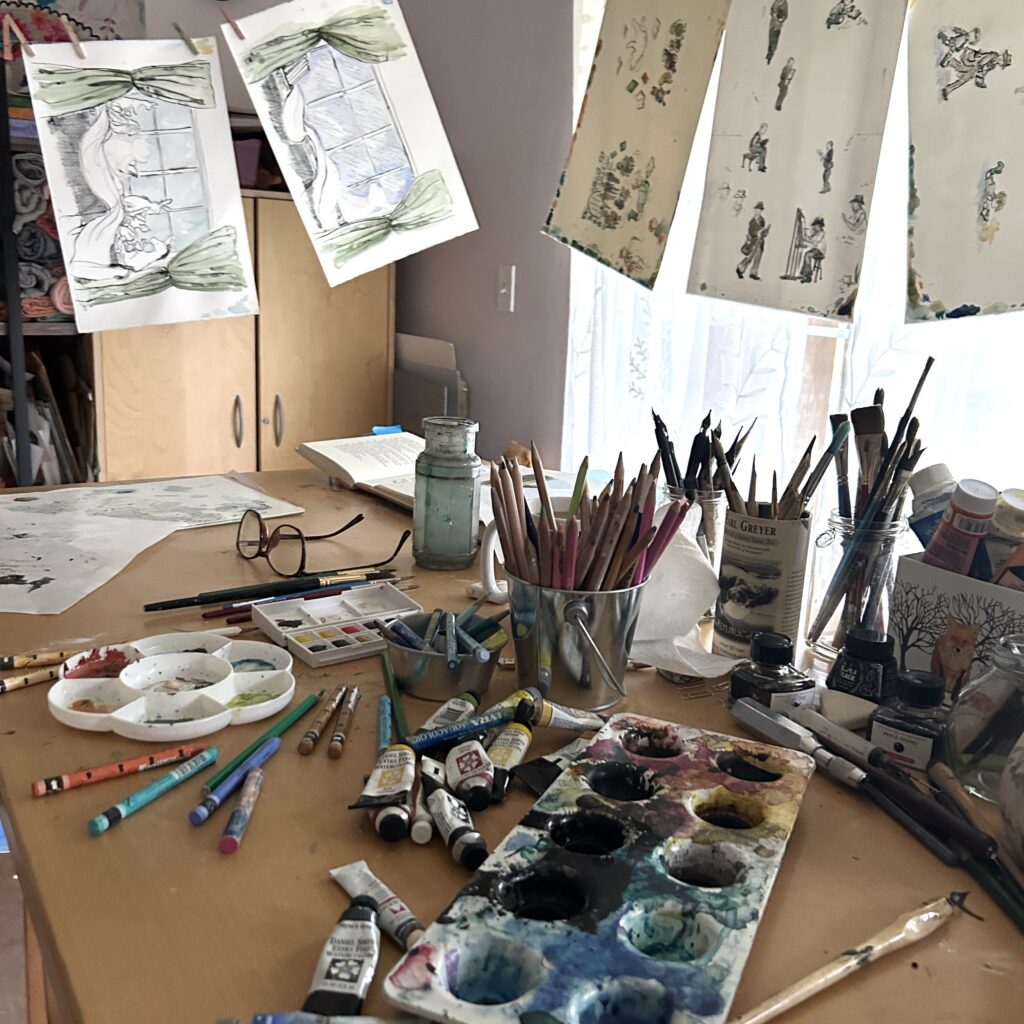
Sometimes having different fonts designated to each character can seem too much visually. But in this case, Annette created a conversation between two characters that allowed having the two fonts speak to each other. Faith included her handwriting as Pooh’s voice during the sketch stage, which led to the playful font of Harimau. There’s so much whimsy when the text can interact with the art.
Annette, what was it like seeing everything finalized? This was originally a straight picture book biography of E.H. Shepard, how did it evolve to acknowledging each person’s collaboration that created Winnie-the-Pooh instead of just focusing on him?
Annette: Melisa, I struggled with how to describe Winnie-the-Pooh’s innovative page layout, and I was so happy when I saw the art because it captured it all so brilliantly. Those pages show how most books looked back then and, with that lovely page turn, show what the Winnie-the-Pooh team did differently.

I love hearing how much you and Mark loved Faith’s art because I felt that way too, right from the time I saw the initial black-and-white sketches. It was clear to me that she had cracked the code of how to visually represent the story. And then when color got layered in it got even better.
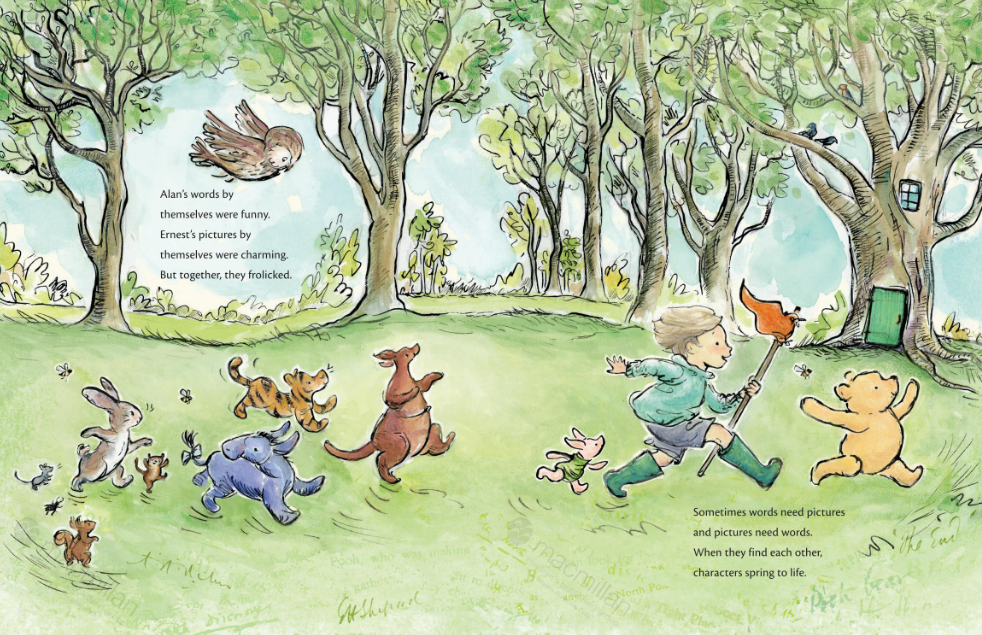
When my critique partners read early drafts, they kept asking me what the heart of the story was. I struggled to answer that question for weeks. I knew I loved Pooh, and I knew that Shepard’s art was an important part of my love, but the why seemed elusive. At last I realized that what was interesting to me about Shepard is exactly what I love about making picture books: as our book says, Milne’s words by themselves were funny and Shepard’s pictures by themselves were charming. But together, they made something even deeper and sweeter. They were better together than apart.
Melisa, I’m curious about how the collaboration between you and Faith worked. Did you and Faith work together on the layout of pages? Who designed the jacket? Or the case cover?
Melisa: Faith did so much of the heavy lifting for the layout of the interiors! From sketches she had the words placed along with her art and I followed in placing the text close to where she had originally placed it. Adjustments would be made to make sure things were consistent in spacing, nudging it if the text seemed too tight with the art, or if it was out of bounds from our guidelines.
The design of the jacket cover was a collaborative effort between Faith, me and one of our behind-the-scenes designers that I’d love to sneak a credit to, Marissa Asuncion! It first started off with Faith sending wonderful cover sketch options. We loved them so much, we used one for the jacket and one for the case. Faith also sent over some lovely handwritten title options, and Marissa and I explored more options on our end. We brought the options to our cover meeting with sales, marketing and our publisher for feedback, and voila, the final cover was born! For the rest of it, Faith had created a wrap for both the jacket and case. I wanted her art to be the main focus, showcasing as much as we could with the text that we needed to include. That led to the back jacket flap not being blocked off like the front flaps.
Faith, I’d love to hear about your ideation process for the cover sketches you had sent us initially. Were there any that you wished were chosen instead of what ended up being selected for the case and jacket?
Faith: I think I ended up with eleven cover sketches that I liked a lot, then narrowed those down to five after thinking about the central themes of our book. My favorite design is the one we picked for the jacket.

I have a question for everyone: what is your favorite part, or page of the book?
Mark: Such a great question. I have a few favorite places in the book. For one, I particularly love the moment when Pooh suggests trapping an illustrator by hole. That moment makes me laugh regardless of how many times I have read the book. Then, I love the endpapers at the back of the book with the entire cast of characters. A big bay window is immediately nostalgic for me, and makes me think of all the time I spent staring out of windows growing up and dreaming. It also reminds me of a favorite picture book of mine, Kevin Henkes’ Waiting.

But, secretly, though no longer much of a secret any more, my favorite part of the book is a tiny piece of spot art in the backmatter where Pooh declares that reading tickles. I love it.
Annette, since this all began with your idea, what if you brought us home with your favorite part?
Annette: In the spread where Pooh first appears, you see only the vaguest shadow of a bear forming amongst the words. At a recent school visit, a kindergartener called it “the ghost bear.” He’s scarcely there, still just a hint. As we move through the book Pooh slowly becomes more definite until, on the last spread, Pooh leads a buoyant parade of characters. Pooh is fully himself, outlined with a confident line. His face is full of expression. No more ghost bear! He’s fully embodied, charming, silly, totally himself. That movement from vague idea to a fully-realized character is what the book is about. Frankly, for me it’s what writing is about too.
Thanks to Annette, Faith, Mark, and Marisa for sharing this conversation with us! And special thank you to Faith, who also sent along a lot of pictures. So many that we couldn’t fit them all! So here’s a carousel of some of our favorites:
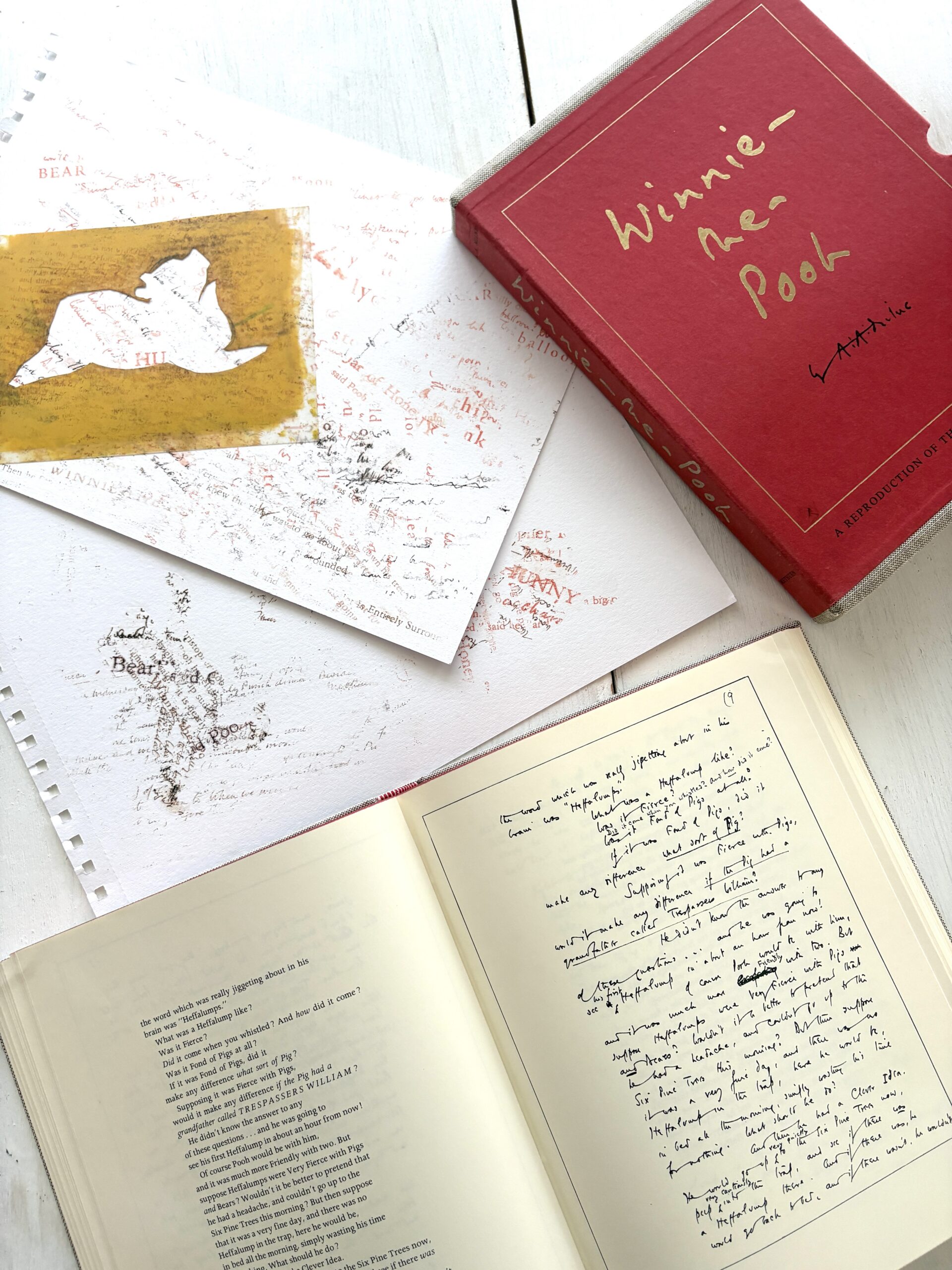
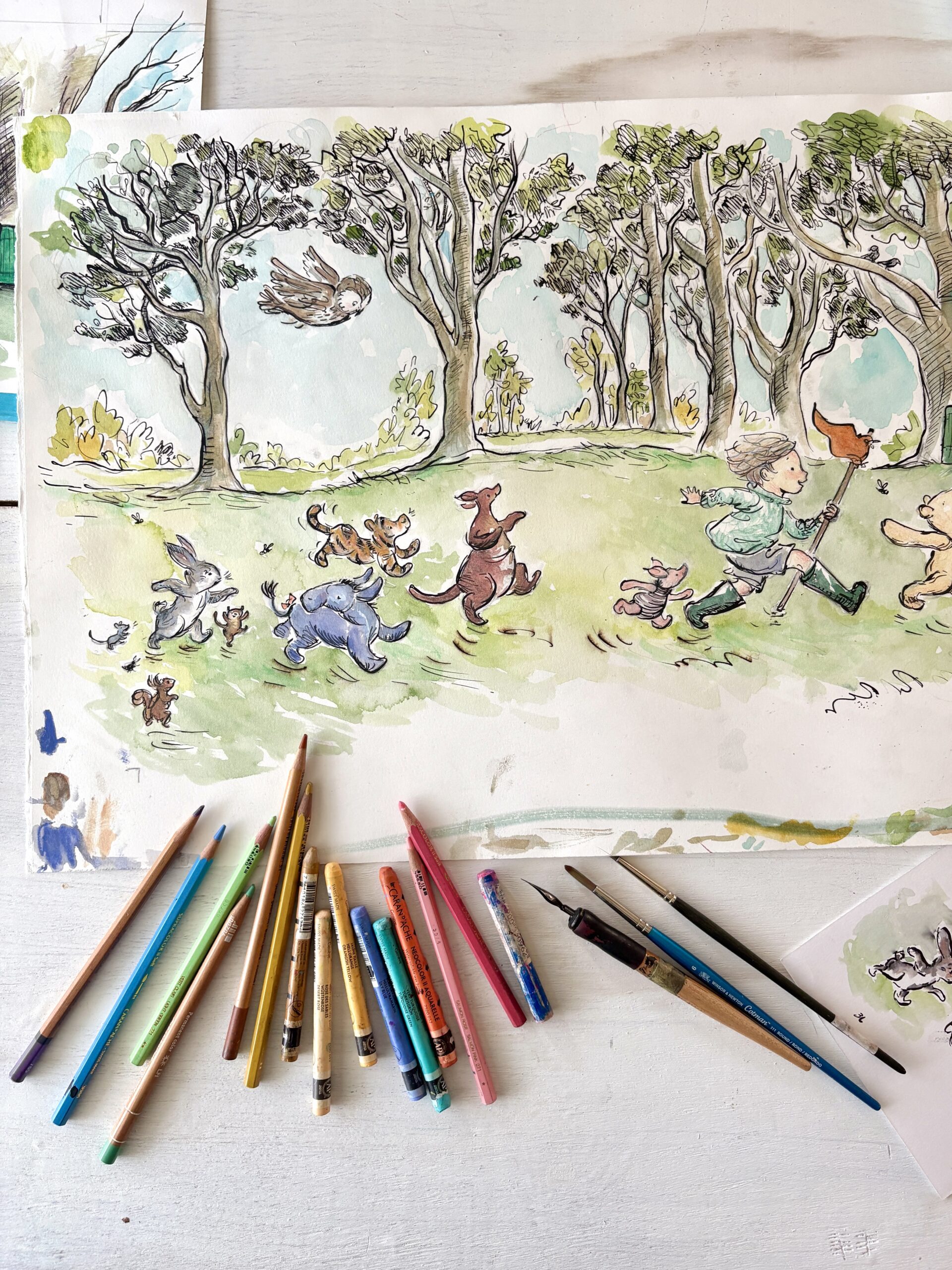
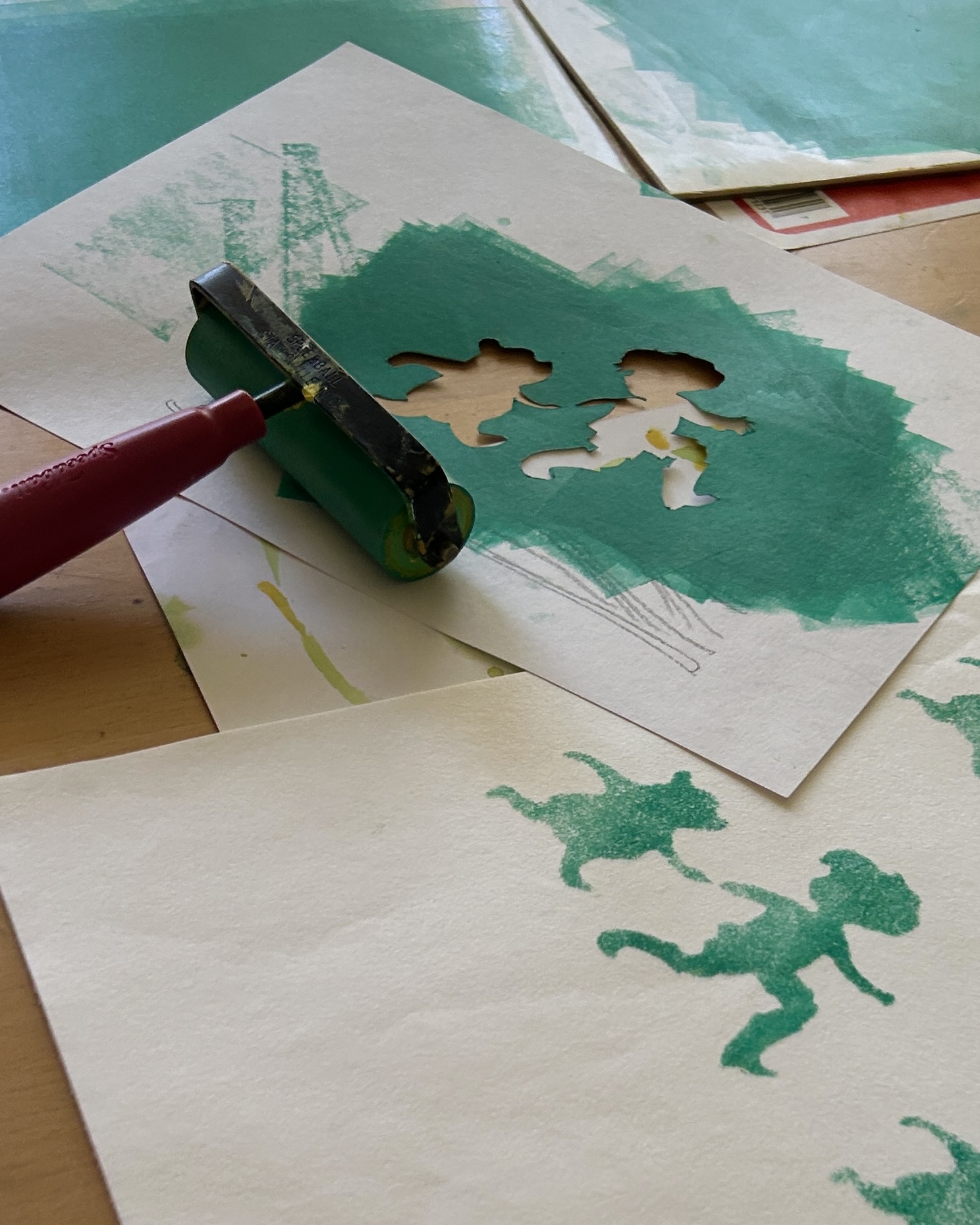
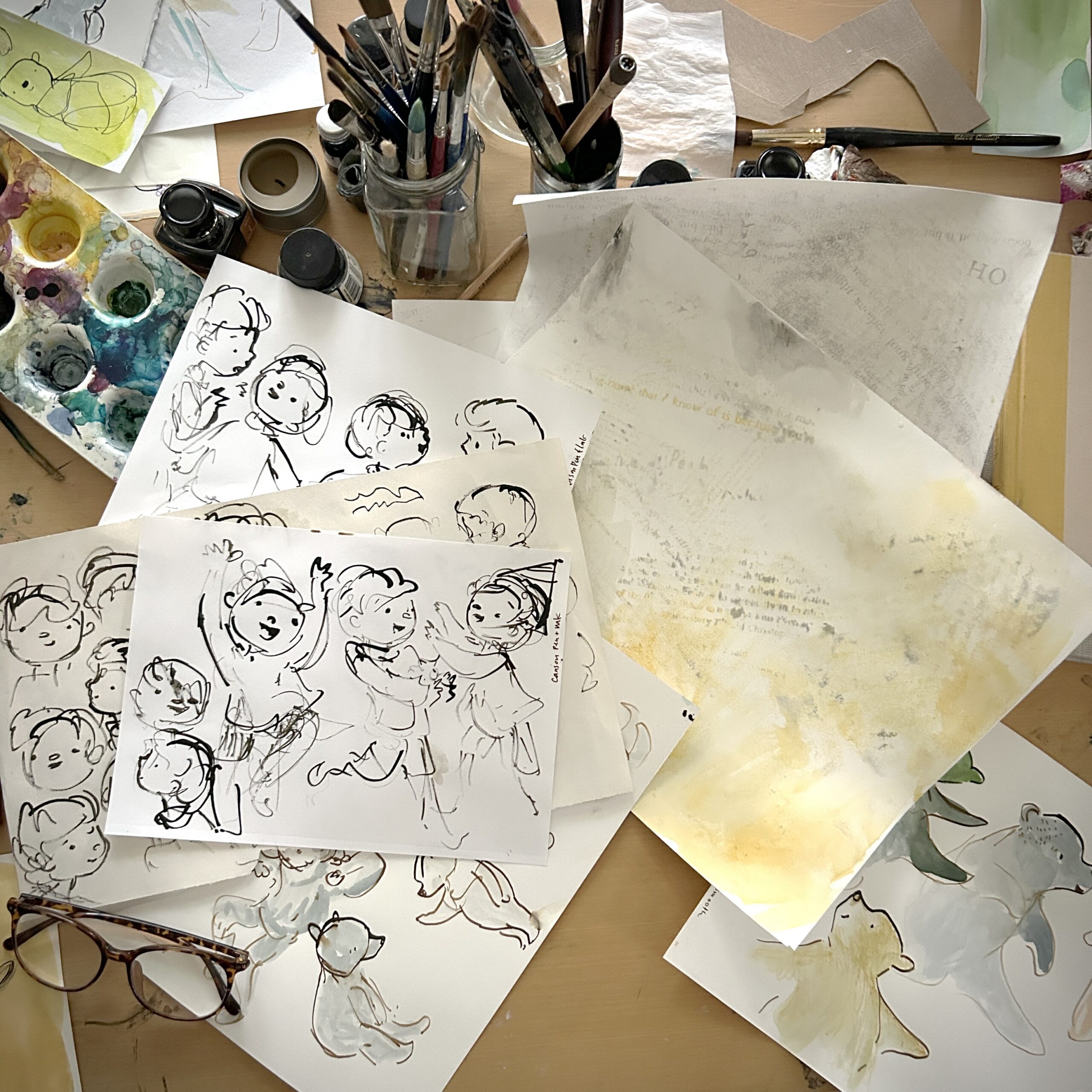
And check out this video which explains even more of the process!
About How a Bear Became a Book

How a Bear Became a Book
By Annette Bay Pimentel; illustrated by Faith Pray
Ages 4-8
On Sale Now!
Celebrate the 100th anniversary of Winnie-the-Pooh with this gorgeous picture book about the creation of the World’s Most Famous Bear!
In 1926, the very first Winnie-the-Pooh book was published. One hundred years later, generations of kids have grown up in the Hundred Acre Wood.
How a Bear Became a Book tells the story of how writer, illustrator, and editor came together to craft Pooh’s first adventure. But deeper than that, this book introduces our youngest readers to how stories begin and where they can go. As Pooh’s voice enters the text, he slowly comes to life in the art.
Textually delightful and visually stunning, this is a picture book about the making of picture books, but it is also a masterful exploration of ideas, storytelling, collaboration, art, and most importantly, honey.
Praise for How a Bear Became a Book
★ “A thoughtful, beautifully crafted title that honors a literary classic on the eve of its centennial and introduces “The Best Bear in All the World” to a new generation.” —School Library Journal, Starred Review
★ “A stunning tribute to a classic that also offers insight into the bookmaking process.” —Kirkus Reviews, Starred Review
★ “Bay Pimentel and Pray highlight the importance of teamwork, pulling back the curtain on the creators who produced the Winnie-the-Pooh books.” —Publishers Weekly, Starred Review
★ “Marking one hundred years since the publication of A. A. Milne’s Winnie-the-Pooh (1926), this thoughtful, well-designed informational picture book pays tribute not only to that book’s creation but also to the process of book creation in general.” —The Horn Book, Starred Review
“Appealing and thorough, a charming companion to the original Pooh stories and an enlightening introduction to how children’s books can evolve.” —Booklist
“This is perfect for a read-aloud to captivate audiences who already know Pooh and are willing to learn a bit more about how he, and other fictional childhood friends, come to be.” —The Bulletin of the Center for Children’s Books